By: Kristen M., Project CAD Lead, PACE Engineers
Building Information Modeling, otherwise known as BIM. You’ve probably heard of it, and there’s a good chance it’s integrated into your workflow. But what does this slightly awkward acronym mean?
BIM: Collaboration & Data Management
If you spend a few minutes searching “BIM” online, you’ll find a plethora of results (approximately 692,000,000) ranging from definitions for the uninitiated to scholarly research papers. Given this vast number of resources, I’ll start by borrowing this conclusive summary from Jin, et al, describing the purpose of BIM: “BIM, by its nature, aims to enhance cross-disciplinary collaboration and communication.”
Rather than being one specific thing, it’s easier and more accurate to think of BIM as a set of processes that support collaboration and data management throughout all stages of a project. Ideally, BIM maximizes sustainability and minimizes costs during construction by investing in the preconstruction phase. The goal is to facilitate a digital environment where information is shared across disciplines, resolving unforeseen issues during the design phase, instead of during construction.
At PACE, we’re involved in two BIM processes: reality capture and model development. We’ll take a closer look at how these processes are used and the benefits they offer.
Reality Capture
If you guessed that reality capture is the process of recording physical data from the world and processing it into a usable digital format, you’re right!
Like BIM, it’s an umbrella term, including anything from advanced LiDAR scans to hand measurements and basic photography. Capturing data doesn’t have to be fancy. But when it is, it enables teams to gather vast quantities of critical information in minimal time. The physical data gleaned from scans and surveys include coordinates, elevations, colors, spatial arrangement of elements, and coded data representing objects such as fences or power lines. Another way to think about it is to gather as much measurable information as possible.
To this end, surveyors work on the front end of many BIM processes, gathering essential data in the field. Ultimately, this data enables model development. Once a scan is created and processed, the data can be imported into CAD software, generating accurate terrain and existing structures for designers to work from. In a nutshell, we utilize many tools to gather key data, the foundation of every design. If you have questions or want to learn more about reality capture, consult a PACE surveyor!


Model Development
Model development generally has one of two starting points: a) creating something fresh based on scan data, or b) designing content to add to a client’s existing project or model. Both starting points rely on reality capture for foundational information.
Once site information is processed and distributed, model development can begin. There’s a lot of modeling software out there, both proprietary and open source. At PACE, we use many Autodesk products like Revit, Navisworks, Autodesk Construction Cloud, ReCap Pro, and Civil 3D. The structural department utilizes Revit to model elements for large-scale industrial projects, ranging from airports to data centers and semiconductor facilities. It’s our software of choice because it enables multiple users to work on a model simultaneously. It can link models from other disciplines via the cloud, processing updates as users make changes. Sometimes, we use it because it’s a project requirement.
On large-scale projects, a viewable (but not editable) version of the main model can be exported to all team members daily, not just modelers and detailers. Free software, such as Navisworks Freedom, is available for viewing the model, making daily exports accessible to just about anyone with a screen; no specialized software or expensive computers are required! Here is where BIM becomes essential to the design process for most people. It enables anyone with access to see changes and coordinate accordingly. Even if you aren’t working in Revit, you can still view the model, flag issues, and pass them along to other parties.

Applications in Preconstruction
Preconstruction is useful for determining design feasibility when you’re short on space, configuring unique elements, or coordinating many disciplines. Having a well-developed model enables the resolution of significant clashes and design issues before construction, instead of during construction. This isn’t to say all problems are solved beforehand, but it reduces significant incompatibilities and aids in the bidding process.
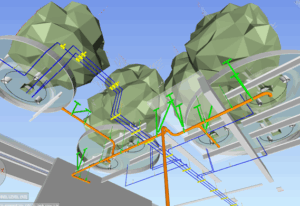
During our work on the Portland Airport Terminal Core Redevelopment (TCORE), the architect and mechanical contractor fleshed out distinctive design elements virtually before construction – tree wells set into the floor and pet relief areas with water supply and drainage systems. Given our geography in the Pacific Northwest, each of these areas required stringent seismic support. And that’s where PACE comes in, designing seismic pipe supports for mechanical systems (see the bright green elements in the image above). Because of the high level of model coordination between the architect and mechanical contractor, our structural team was able to design and locate each support precisely.
Using tools enabling near-real-time updates is part of the day-to-day routine on large industrial projects. Once the magic of flying around a model wears off, it’s easy to forget how amazing the this technology really is—and how new it is, especially when compared to the history of construction or engineering. So, when the software feels cumbersome and limiting, think of your modeler as part of a historic R&D effort, and remember the emerging technologies enabling BIM are still quite young compared to other parts of the industries they support. As BIM technology progresses, we have much to look forward to in the coming decades.

Industry Adoption
BIM use is rising globally, and committees like buildingSMART International and National BIM Standard (NBIMS) are working to “improve project delivery and operational processes.” Targeting issues related to file type standardization, level of detail, and model component classification, they aim to develop a common set of practices anyone can rely on when defining project deliverables. BIM is already widely used in Scandinavia, Singapore, France, the UK, UAE, EU, Australia, China, India, Russia, and the US, to name (quite) a few! In some countries, mandates require BIM use based on project size, funding, or other the use of BIM based on project size, funding, or other specific metrics. Stanford University offers internationally recognized courses focused on BIM and Virtual Design & Construction (VDC).
Each year, modelers, developers, and designers from around the globe gather at Autodesk University to share knowledge, hacks, and workflows through live courses and demos. Or you can log onto AUGI, Autodesk User Group International, to look up relic solutions from decades past. From personal experience, expert Revit users from the Balkans, France, and Australia have taught me a lot.
The global development of technology and information sharing, which drives BIM processes, reflects what makes BIM successful to begin with. This global development of technology and information sharing driving BIM processes reflects what makes BIM successful to begin with. As a practice, BIM invites a spirit of collaboration and openness. Working together in a model, sharing information freely, and sending live updates to other companies to make projects of any scale possible, even over great geographic distances. And when the demand is there, it’s possible to have teams working around the clock from different time zones, thanks to the magic of the cloud and globally adopted technology.
So, what is BIM?
Think of it as a series of processes centered around a model – an information-sharing hub. With 3D visualization comes the ability to communicate using images – circling something and asking, “Can you please move your conduit over?” or “We need to move the whole system to another building because of X,Y, Z.” BIM doesn’t just facilitate hard data, such as quantities and dimensions; it gets people talking. And above all else, communication is key to the success of any great project.
Sources
- BIM Investment, Returns, and Risks in China’s AEC Industries | Authors: Ruoyu Jin, Craig Matthew Hancock, Llewellyn Tang, Dariusz Wanatowski, M.ASCE
- National BIM Standard – United States | Mission Statement: “The mission of the National BIM Standard-United States Project Committee as identified in the Rules of Governance is to lead the development and deployment of broadly adopted national information standards and best practices for the built environment, with a focus on significantly improving project delivery and operational processes.”
- The Global Wave of BIM Adoption around the World | Novatr
- Leading Countries with BIM Adoption | United BIM
- Professional VDC Education | Stanford Engineering, Center for Integrated Facility Engineering
Link
Hardcopy link to the white paper: BIM (Building Information Modeling)